Reuters and Al Jazeera have reported in recent weeks on renewed signals from Ankara toward a fresh round of engagement with imprisoned PKK founder Abdullah Öcalan, with Turkish government-aligned figures and the pro-Kurdish DEM Party (Halkların Eşitlik ve Demokrasi Partisi) confirming a live back-channel and DEM legislators making supervised visits to Öcalan at Imrali Island Prison for the first time in years. The overture has generated the most sustained diplomatic energy around the Kurdish question in Turkey since the collapse of the so-called solution process a decade ago.
The stakes could not be higher — for Turkey’s southeastern provinces, for the Syrian Democratic Forces holding northeast Syria, for Yezidi and Assyrian communities whose security architecture depends on what happens between Ankara and the Kurdish political movement. But the structural conditions that caused the 2013–2015 process to implode have not been repaired. No legal framework was built then. None has been built now. That is the story of May 2026.
What Killed the Last Process
The solution process — çözüm süreci, meaning literally the resolution process — began with genuine momentum. Öcalan issued a historic ceasefire declaration in March 2013, PKK fighters began a staged withdrawal from Turkish soil, and public opinion in Kurdish cities ran briefly ahead of the politicians. What followed was a masterclass in how to destroy a peace process without signing a single document ending it.
Three structural failures defined the collapse. First, there was no legal framework: no amnesty legislation, no disarmament protocol, no parliamentary statute that could survive a change in the political weather. Everything rested on informal understandings between Öcalan’s lawyers, PKK commanders in the Kandil mountains, and the intelligence service MİT — a chain of trust that snapped the moment Ankara decided, in mid-2015, that electoral arithmetic favored hardline nationalism over a settlement. The HDP’s breakthrough performance in the June 2015 elections, crossing the ten-percent parliamentary threshold, gave President Erdoğan a reason to restart the war rather than share power in a pluralist parliament.
Second, there was no third-party monitoring. The United Nations, the European Union, and Norway — which had facilitated earlier Oslo back-channels — were kept at arm’s length. Without an international guarantor, neither side had a credible mechanism to verify compliance or de-escalate when local commanders on either side violated the ceasefire spirit.
Third, and most fundamentally, there was no constitutional Kurdish recognition. Kurdish identity, language rights, and political autonomy remained outside the text of any proposed legal settlement. Öcalan’s democratic confederalism framework — the political philosophy he developed in Imrali, drawing on Murray Bookchin’s municipalism and adapted to Middle Eastern conditions — was never seriously engaged by Ankara as a constitutional interlocutor. It was treated as a negotiating position to be managed, not a political vision to be addressed.
A peace process built on informal trust and no legal architecture is not a process — it is a postponement of the next war.
The 2026 Parameters: What Has Changed, What Hasn’t
The regional context is genuinely different this time. The fall of Bashar al-Assad’s government in Damascus in late 2024 reshuffled every security calculation in the region. Turkey moved rapidly to shape the post-Assad order, backing armed factions that have put the Syrian Democratic Forces and the Autonomous Administration of North and East Syria (AANES) under sustained military and political pressure. That pressure gives Ankara leverage — but it also creates a perverse incentive structure: why negotiate a political settlement with Öcalan if you can simply strangle the Rojava project militarily and present the PKK with a fait accompli?
DEM Party’s conditional engagement is the most credible new variable. The party’s leadership has been explicit, in widely covered public statements, that it will not serve as a conveyor belt for a process that ends with disarmament and no political gains. DEM legislators have demanded, as a precondition for continued participation, that Öcalan be transferred from Imrali’s isolation regime to conditions that allow genuine political communication — not supervised visits filtered through prison administration. Human Rights Watch has documented Öcalan’s near-total isolation over more than two decades as a violation of European Convention standards, a finding the Council of Europe‘s Committee of Ministers has repeatedly echoed.
What has not changed: there is still no proposed legal framework. There is still no third-party monitoring mechanism. The Turkish constitution still contains no recognition of Kurdish collective political rights. The closure indictment against DEM’s predecessor parties — a template recycled through HEP, DEP, HADEP, DEHAP, DTP, BDP, HDP, and now DEM — remains a standing threat. Prosecutors can, and historically do, move against Kurdish party leadership at the precise moment a peace process reaches its most sensitive stage.
The post-Assad regional moment creates a narrow window. Kurdish political actors from Ankara to Qamishlo to Sulaymaniyah understand that windows close. But a process that repeats the architecture of 2013 — informal, unmonitored, constitutionally unanchored — will reproduce the outcome of 2015. The next scheduled DEM-facilitated contact with Öcalan, according to reporting by BBC correspondents covering Turkey, is expected before the end of May 2026. That date is the first real test of whether Ankara is negotiating a settlement or managing an optic.
Next marker: end of May 2026 — the anticipated follow-up Imrali contact and any formal DEM response to Ankara’s framework proposals.
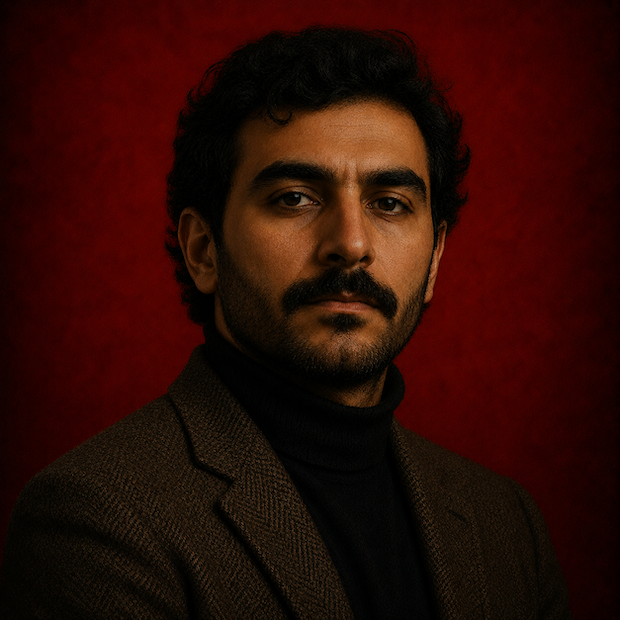
Azad Bedirxan is a Kurdish journalist covering the politics of a stateless nation divided across four borders. He has reported from Diyarbakir before mayors were jailed, from Qamishli before the Turkish drones, from Sulaymaniyah while the KDP-PUK rivalry was still about oil rents, and from Mahmur when the camp was still standing. He reads court files in Kurmanji and Turkish, communiques in Sorani, and Western policy papers in English. He knows the difference between PKK, PYD, YPG, Peshmerga, KDP, PUK, HDP, DEM, KCK, and Komala — and he will gently insist that you should too.