The BBC reported this Saturday the story of Jay Lovell, an engineer who has worked shifts at Wembley Stadium and will instead play there this Sunday in the FA Vase final — the kind of story that travels fast because it is genuinely warm, a man arriving at the same address by a different door. It deserves its moment. But the moment also deserves its context, because the same weekend that Lovell laces up his boots at Wembley, Palestinian amateur footballers in the occupied West Bank cannot obtain the permits to cross Israeli military checkpoints to reach their own clubs, their own pitches, their own leagues — let alone a national final.
That contrast is not incidental. It is structural. The right to move, to gather, to play — rights so assumed in the FA Vase narrative that they go unmentioned — have been systematically curtailed for Palestinians under a permit regime that B’Tselem and Human Rights Watch have documented across decades of reporting. Since October 2023, that regime has tightened further: movement restrictions across the West Bank have intensified, and in Gaza the question of football has been rendered almost obscene by the scale of destruction, with pitches bombed, club infrastructure flattened, and players killed.
Clubs folded, pitches bombed, players killed
The Al Jazeera and Guardian have both reported on Palestinian footballers who died in Israeli strikes in Gaza since late 2023, among them members of local clubs who had no combatant role. The Palestinian Football Association has repeatedly documented the destruction of football infrastructure across Gaza. Pitches that served as community anchors — places where the Prophet’s instruction to tend to the body found its most ordinary expression — have been reduced to rubble or repurposed as displacement sites. In the West Bank, the calculus is different but the effect is related: checkpoint delays and permit denials mean inter-city league fixtures collapse, amateur clubs cannot field consistent squads, and youth development programs stall. Grassroots sport requires freedom of movement. Occupation removes it.
The right to move, to gather, to play — rights so assumed in the FA Vase narrative that they go unmentioned — have been systematically curtailed for Palestinians under a permit regime documented across decades.
The Palestinian Football Association — the PFA, known in Arabic as the Ittihad Kurat al-Qadam al-Filastini, the Palestinian football union — has this month renewed its calls on FIFA and the broader international football governance structure to suspend the Israel Football Association. The argument is grounded in FIFA’s own statutes, specifically provisions that hold member associations responsible for ensuring football can be played across their territory without discrimination and without interference from third parties. The PFA’s position, consistently held and publicly stated, is that the IFA operates under a state that makes Palestinian football structurally impossible, and that FIFA’s own rules require a response.
FIFA’s silence and the statute it won’t enforce
FIFA has not suspended the IFA. A motion at the FIFA Congress in 2024 failed to achieve the required threshold, and no equivalent binding vote has succeeded since. The organisation has instead pointed to a monitoring process — a committee established to assess the situation — whose findings have not translated into enforceable action. Amnesty International and rights observers have noted the disparity with FIFA’s treatment of Russia, whose football federation was suspended following the 2022 invasion of Ukraine. The comparison is imperfect in its details but pointed in its principle: international governing bodies move when political will among powerful member states exists, and on Palestine that will remains absent.
None of this diminishes Jay Lovell’s Sunday. The FA Vase final is a real thing, his story is a real story, and the BBC was right to tell it. But the viral logic of human-interest sport journalism — the engineer who gets to play where he works — depends on a set of background conditions so naturalised they become invisible: that a man can travel to a stadium, that his league has not been suspended by military closure, that his teammates can reach the ground, that the ground itself still stands. For Palestinian footballers, those background conditions are the story. They are what has been taken. The word for what remains when all of that is stripped away is not misfortune. It is dispossession — al-nakba al-mustamirra, the ongoing catastrophe — and it shows up even in the sports pages, if you know how to read it.
The next FIFA Council meeting is scheduled for June 2026. The Palestinian Football Association’s formal complaint remains on record with FIFA’s governance bodies.
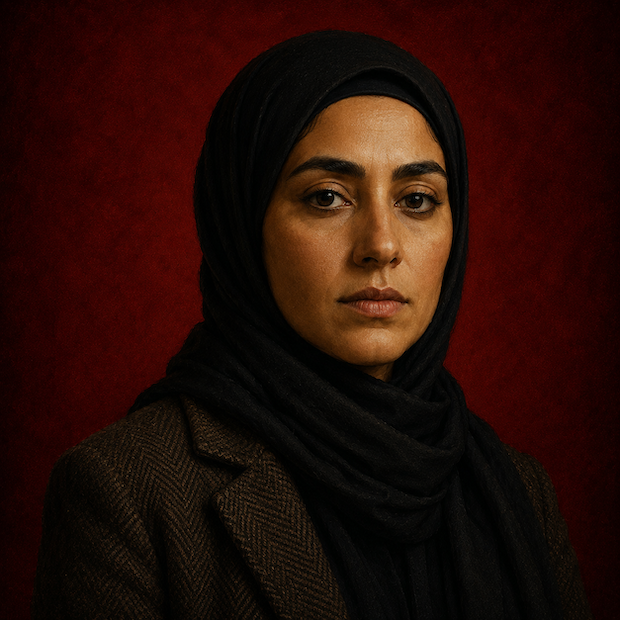
Reem el-Hassan is a Lebanese journalist, hijabi, and devout Muslim who reports on Palestine and Lebanon for Noizez. She has spent her career refusing the choice — repeatedly demanded by Western editors — between being a religious woman and a serious political writer. She files from Beirut, Hebron, Gaza when she can reach it, and the long-distance archives of Sabra-Shatila when she cannot. She reads in Arabic, English, and the silences in between.